


The Murin Laboratory Awarded $4.7 Million NIH Grant to Design a New Generation of HIV Antibody Therapies
This project will use one of the world’s most powerful microscopes to watch immune cells attack HIV — then use machine learning to build better antibodies.
San Diego BioMed is happy to announce that Charles Daniel Murin, Ph.D., Assistant Professor, has received a five-year, $4.7 million R01 grant from the National Institute of Allergy and Infectious Diseases (NIAID), part of the National Institutes of Health, to investigate how the immune system destroys HIV-infected cells, and to use that knowledge to design entirely new antibody drugs.
Even with effective antiretroviral therapy, HIV persists in the body in a small pool of infected cells known as the viral reservoir, which is why treatment must continue for life. Clearing that reservoir is one of the central challenges in the search for an HIV cure.
The Murin laboratory is focused on natural killer (NK) cells, immune cells that can kill infected cells once antibodies have marked them for destruction, a process called antibody-dependent cellular cytotoxicity, or ADCC. Antibodies vary widely in how well they trigger this response, and researchers have not been able to predict which ones will work best, or why.
Part of the answer, Murin’s team believes, lies in physical arrangement: exactly how HIV’s surface protein, called Env, and the antibodies bound to it are positioned on the surface of an infected cell. Those distances are measured in billionths of a meter, far too small for conventional microscopes to resolve.
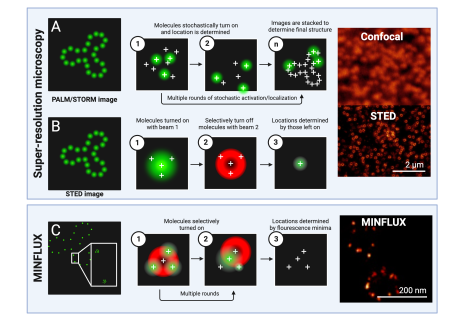
To see them, the team will use MINFLUX nanoscopy, an emerging imaging technology capable of pinpointing individual molecules to within a few nanometers. The Murin lab recently used the technique to show that a key antibody receptor on NK cells sits in pairs on the cell surface, a detail invisible to earlier methods. The new project will apply the same approach to HIV Env on target cells for the first time.
The measurements will then feed into machine learning models that predict which antibody designs will provoke the strongest immune attack. In the project’s final phase, the team will use those models to design small synthetic antibodies, called nanobodies, from scratch in a computer, then test the most promising candidates in the laboratory.
“For decades we’ve discovered antibodies by finding them in patients and hoping they do what we need. This project is about the opposite approach: measure precisely what makes an antibody good at killing infected cells, then design one to those specifications. If it works, it gives us a blueprint rather than a lucky find.”
— Charles Daniel Murin, Ph.D., Principal Investigator
Murin leads the project with co-principal investigator Daniel Montiel Garcia, Ph.D., of Scripps Research, who directs the computational design work. Co-investigators Lars Hangartner, Ph.D., and Andrew Ward, Ph.D., both of Scripps Research, contribute expertise in NK cell immunology and HIV structural biology. All four laboratories sit within a five-minute walk of one another in the Torrey Pines research corridor.
“This award reflects exactly the kind of science [our institute] was built to support,” says Joanna Davies, President and CEO of San Diego BioMed. “Dr. Murin’s approach takes full advantage of San Diego’s collaborative research community, and demonstrates how a small independent institute can like San Diego BioMed can pursue high-risk, technically demanding work to deliver solutions to the toughest challenges facing human health.”
The grant, award number R01AI198054, began September 1, 2026, and runs through August 2031.
Research reported in this release is supported by the National Institute of Allergy and Infectious Diseases of the National Institutes of Health under Award Number R01AI198054. The content is solely the responsibility of the authors and does not necessarily represent the official views of the National Institutes of Health.