


Distinct Roles of Dopamine Receptors in HIV Latency Reversal in a Myeloid Cell Model
Congratulations to the joined effort of San Diego BioMed’s Marcondes Lab and their collaborators in the recent release of their paper publication in Frontiers in Immunology!
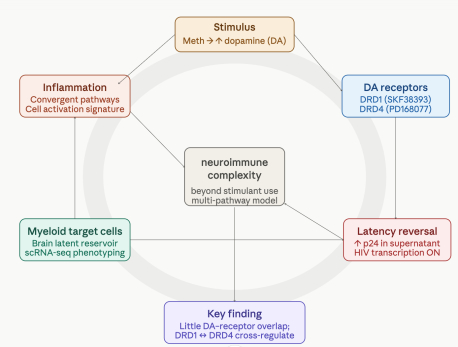
Stimulant drugs like methamphetamine elevate brain dopamine (DA) levels, which can reactivate latent HIV in myeloid brain cells — a key reservoir of virus in people living with HIV. However, the specific receptors and pathways responsible have remained poorly defined. In this study, the Marcondes lab shows that two DA receptors, DRD1 and DRD4, independently increase HIV transcriptional activity in latently infected cells, but with surprisingly little overlap in the gene clusters, pathways, or upstream regulators they engage compared to DA itself. Instead, the two receptors share more in common with each other than with DA, suggesting cross-regulation between DRD1 and DRD4 signaling. Despite these mechanistic differences, convergent inflammatory and cell activation signatures emerged across all conditions, identifying a shared downstream consequence regardless of which receptor is engaged. These findings are relevant beyond stimulant use: they reveal that neuroimmune modulation of HIV latency in the brain is inherently multi-pathway and cannot be captured by studying single receptors or neurotransmitters in isolation, with direct implications for designing targeted interventions against the brain viral reservoir in HIV-associated neurocognitive disorders.